


Modern digital tools are changing how we discover things. They bring advanced computational power to the lab. This makes old ways of working more efficient and data-focused.
Artificial intelligence can now quickly go through complex data. This is much faster than humans. It leads to big discoveries in fields like medicine and astronomy.
This change is not just about being quicker. It also changes how we think and do research. New tools like lab automation and simulation software open up new ways to explore.
This tech change is a big leap forward. It makes new discoveries possible while keeping research standards high.
The Digital Revolution in Scientific Methodology
Scientific research has changed a lot, moving from old paper methods to new digital systems. This big change has changed how scientists gather, handle, and study data.
Transformation from Analog to Digital Research
Switching from paper notebooks to electronic systems is a big step forward. Electronic lab notebooks make data easy to search, share, and keep track of. This gets rid of paper’s limits.
Now, researchers can work from any device, team up in real-time, and keep track of changes easily. This makes finding new things faster, as shown by Carnegie Mellon University’s work.
Electronic lab notebooks replacing paper records
These digital tools are better at keeping things organised than paper notebooks. They let you search your whole research history with a keyword and share data easily. This means no more lost papers or damage.
Related Posts:






Automation of routine measurement and calibration tasks
Today’s labs use machines for tasks that used to take a lot of time. This lets scientists focus on harder tasks and planning experiments.
Before, calibrating equipment needed a lot of human effort. Now, machines do it with more accuracy and less chance of mistakes. This makes labs work better and faster.
Fundamental Shifts in Research Infrastructure
The digital change isn’t just about tools; it’s about whole labs. Digital systems now manage everything from supplies to experiments on one platform.
These systems make labs work better by streamlining tasks and keeping records of everything. This makes research more reliable and easier to repeat.
Integrated digital laboratory management systems
These systems link different parts of labs together. They handle things like scheduling, supplies, and safety rules through one system.
This makes labs more efficient, where data moves smoothly between tools and storage. It’s a big change in how labs work together.
Standardised data formats enabling cross-study analysis
Using the same data formats has changed how researchers work together. It lets them mix and study data from different places without problems.
This makes it easier to do big studies and find new things faster. The digital change has made a common language for sharing data.
These changes help create systems that can work on many studies at once. They let AI find patterns that were hard to see before.
Big Data Analytics: Unlocking Patterns at Scale
The digital age has brought a huge change in how scientists work. Big data analytics helps them find important insights from huge amounts of data. This was not possible before.

Managing Massive Research Datasets
Today, scientific experiments create a lot of data. Big data analytics science has come up with ways to deal with this big data.
Large Hadron Collider’s petabyte-scale data processing
The Large Hadron Collider is a big challenge in data processing. It makes about 30 petabytes of data every year. This data is processed by computers in hundreds of places around the world.
Scientists use special algorithms to find interesting data among billions of normal interactions. This effort has led to big discoveries about particles and forces.
Human Genome Project’s data management advancements
The Human Genome Project was a big step in managing data in biology. It sequenced the first human genome, which was 3 billion base pairs long.
This project created new ways to compress and store data. These methods have made genetic analysis cheaper and faster.
Accelerated Discovery Through Pattern Recognition
Big data analytics does more than just manage data. It helps find complex patterns and connections that are hard to see by hand. This is changing many scientific fields.
Identifying disease correlations in healthcare databases
Medical researchers look at millions of patient records to find disease patterns. Google’s AI system shows how machine learning can make new discoveries in healthcare.
These systems can find risk factors and how treatments work. This leads to better healthcare for everyone.
Climate pattern analysis through historical data mining
Climate scientists use old weather data to understand the environment. They use algorithms to find trends and predict the future. This helps make better plans for dealing with climate change.
This work has given us important insights into oceans, atmosphere, and ecosystems. It helps make policies to protect our planet.
Big data analytics is changing science by letting us ask new questions. Carnegie Mellon researchers say it’s a big challenge and a great chance for discovery.
Artificial Intelligence Revolutionising Research Processes
Artificial intelligence has grown from a helper to a key player in science. It now creates hypotheses, designs experiments, and analyses data on a huge scale.
AI-Driven Hypothesis Generation and Testing
Today’s AI can make and test scientific theories on its own. Google’s AI co-scientist is a big step forward. It looks at old research to suggest new ideas that humans might miss.
DeepMind’s AlphaFold predicting protein structures
DeepMind’s AlphaFold is a big win for biology. It can guess how proteins fold, a mystery for years. This helps find new drugs and understand life better.
Machine learning identifying new material combinations
Machine learning checks millions of materials to find new ones. It looks at atoms and their properties to find materials with special features. This includes superconductors and strong alloys.
Intelligent Automation in Experimentation
AI has changed labs with smart automation. Carnegie Mellon’s robots do experiments, check results, and change settings by themselves.
Self-optimising chemical synthesis platforms
AI has made making new materials better. It adjusts how reactions happen to get the best results. It learns from each try to get even better next time.
AI-assisted drug candidate screening systems
AI has changed finding new medicines. It checks millions of compounds to see if they work. This makes finding new drugs faster and cheaper.
MIT FutureTech is working on AI for science. They think it will solve big problems in math and physics soon. AI is making research faster and bigger than ever before, opening up new areas of science.
High-Performance Computing Enabling Complex Modelling
Today, research relies on advanced computing to study natural phenomena. This power lets scientists build detailed models that were once impossible. High-performance computing is key to advancing science in many fields.
Supercomputing Applications in Research
Supercomputers are the top tools for scientific study. They handle huge datasets fast, making complex simulations possible. This helps us understand everything from biology to space.
Climate change simulations on IBM Summit supercomputer
The IBM Summit at Oak Ridge National Laboratory runs detailed climate models. These models look at many factors like air chemistry and ocean flows. They help predict future climate changes with great accuracy.
Cosmological simulations of universe evolution
Supercomputers help cosmologists study the universe’s history. They track galaxy formation and dark matter. This research answers big questions about our universe.

Distributed Computing Contributions
Distributed networks use millions of devices worldwide for computing. This makes computing power more accessible. It’s great for big projects needing lots of processing.
Folding@home protein folding simulations
Folding@home uses volunteers’ computers to study protein folding. This research helps understand diseases like Alzheimer’s. It’s made a huge impact on medicine and biology.
BOINC platform enabling citizen science participation
The BOINC platform lets people use their idle computers for science. You can help with many projects, from astronomy to math. It’s a big help for science.
Computational methods let scientists test ideas through simulation, not just experiments. Carnegie Mellon talks about this big. It’s changed how we do science, making it more efficient and accurate.
High-performance computing keeps getting better, opening up new scientific areas. It lets us solve complex problems like molecular dynamics and galaxy formation. This power is changing how we test ideas and explore the world.
Cloud Computing: Democratising Research Capabilities
Cloud computing is changing how we do science. It lets researchers use powerful computers easily. Before, only big groups could afford this.
Remote Research Collaboration Platforms
Big tech companies have made special places for science. These places let people from all over work together on big projects.
Microsoft Azure and Amazon Web Services Research Environments
Microsoft Azure has a special program for research. It gives tools for handling lots of data. Amazon Web Services also helps with big projects, like studying the climate.
Google Cloud Platform’s Scientific Computing Solutions
Google Cloud Platform has tools for science. It has special tools for learning and data analysis. This helps with big data and complex experiments.
Cost-Effective Computational Access
Cloud computing changes how we pay for computers. It lets groups use top computers without buying them.
Pay-per-use Modelling for Smaller Research Institutions
Small places can now compete with big ones. They use cloud resources. The National AI Research Resource (NAIRR) helps make AI more accessible.
“Cloud computing eliminates the computational advantage that well-funded institutions traditionally held, creating a more level playing field for scientific discovery.”
Scalable Storage Solutions for Large Datasets
Research makes huge amounts of data. Clouds offer lots of space for this data. This means no worries about running out of room.
Researchers can handle huge amounts of data without buying expensive equipment. This is great for fields like astronomy and genomics.
Cloud computing is a big step forward for science. It makes it easier for everyone to work together. This speeds up discoveries and makes powerful tools available to all.
Advanced Imaging and Sensor Technology Breakthroughs
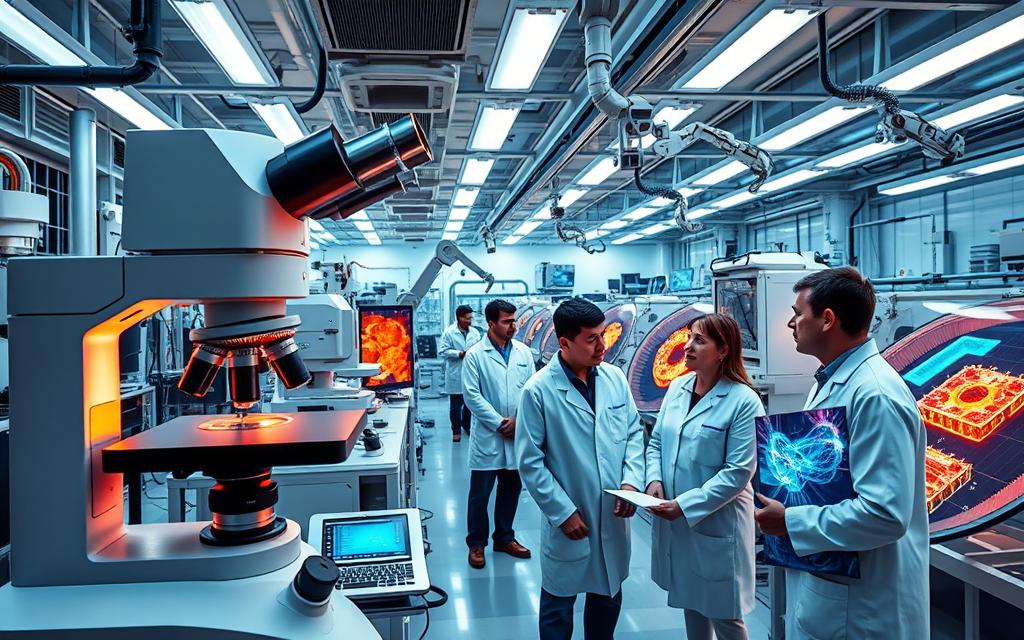
Scientific observation has changed a lot thanks to new imaging and sensing tech. These tools let researchers see things from tiny atoms to huge cosmic distances. They’ve changed how we measure and understand our world.
Revolutionary Observation and Measurement
Today’s scientific tools are super precise. Carnegie Mellon University researchers say these tech advances have led to a lot of high-resolution data. This data helps us discover new things in many fields.
Cryo-electron microscopy advancing structural biology
Cryo-electron microscopy is a big step forward in studying biology. It lets scientists see complex molecules very clearly without needing to crystallise them. This helps them understand proteins and cells better, speeding up drug discovery and research.
James Webb Space Telescope transforming astronomy
The James Webb Space Telescope has changed how we look at the universe. It can see deeper into space than any other telescope. Scientists are finding ancient galaxies, studying exoplanet atmospheres, and seeing cosmic events we couldn’t see before.
Real-time Monitoring Systems
Systems for constant monitoring have changed how we collect and study data. They give us real-time insights. This helps us understand and respond to complex processes quickly.
Internet of Things sensors in environmental research
IoT sensors are key in environmental science. They track air quality, water, and ecosystem health constantly. This data helps scientists track changes, predict events, and create better conservation plans.
Advanced medical imaging accelerating diagnostics
Medical imaging has been transformed by new tech. MRI, CT, and PET scans show us what’s inside our bodies in detail. These tools help doctors find diseases early, make accurate diagnoses, and plan treatments that fit each patient. This improves health care a lot.
The link between advanced imaging and computer analysis is strong. High-quality data from these tools needs complex processing. But, better computers let us make even more advanced imaging tools. This cycle of improvement helps science move forward in fields like medicine and astronomy.
How Technology Can Affect Scientific Research Collaboration
Today’s tech has changed how researchers team up. It makes their work more efficient, open, and global. This leads to faster discoveries through better teamwork.
Accelerating Knowledge Discovery and Synthesis
Artificial intelligence is now a big help. It quickly sorts through lots of data. This lets researchers find connections they might miss.
AI-powered literature review tools like IBM Watson
IBM Watson and others can scan thousands of papers in minutes. They find important points, spot gaps, and suggest team-ups. This cuts down the time spent on reading papers.
Automated systematic review platforms
These platforms use AI to review studies systematically. They keep research quality high while handling more studies than humans can.

Enhancing Global Research Cooperation
Now, distance doesn’t stop research teams from working together. Digital tools let scientists worldwide collaborate. This brings in different views and skills.
Digital collaboration platforms like Slack and Microsoft Teams
Platforms like Slack and Microsoft Teams offer virtual spaces. Here, teams can share data, talk about results, and plan experiments. They work for all time zones and schedules.
Open peer review systems increasing transparency
Open peer review makes feedback clear and shared. Researchers see comments and changes. This leads to better research.
Google’s AI co-scientist shows AI’s role in research. Carnegie Mellon University also promotes teamwork through tech. They bring experts from various fields together.
| Collaboration Tool Type | Primary Function | Key Benefits | Example Platforms |
|---|---|---|---|
| AI Literature Review | Rapid analysis of research papers | Time savings, pattern recognition | IBM Watson, Semantic Scholar |
| Systematic Review Platforms | Automated study screening | Methodological rigour, complete coverage | Covidence, Rayyan |
| Team Communication | Real-time collaboration | Global connection, document sharing | Slack, Microsoft Teams |
| Open Peer Review | Transparent evaluation process | Enhanced feedback, quality boost | PubPeer, F1000Research |
These tools mark a big change in research. They move from solo work to global teams. This uses everyone’s skills and resources, speeding up discoveries.
Interdisciplinary Research Enabled by Technological Integration
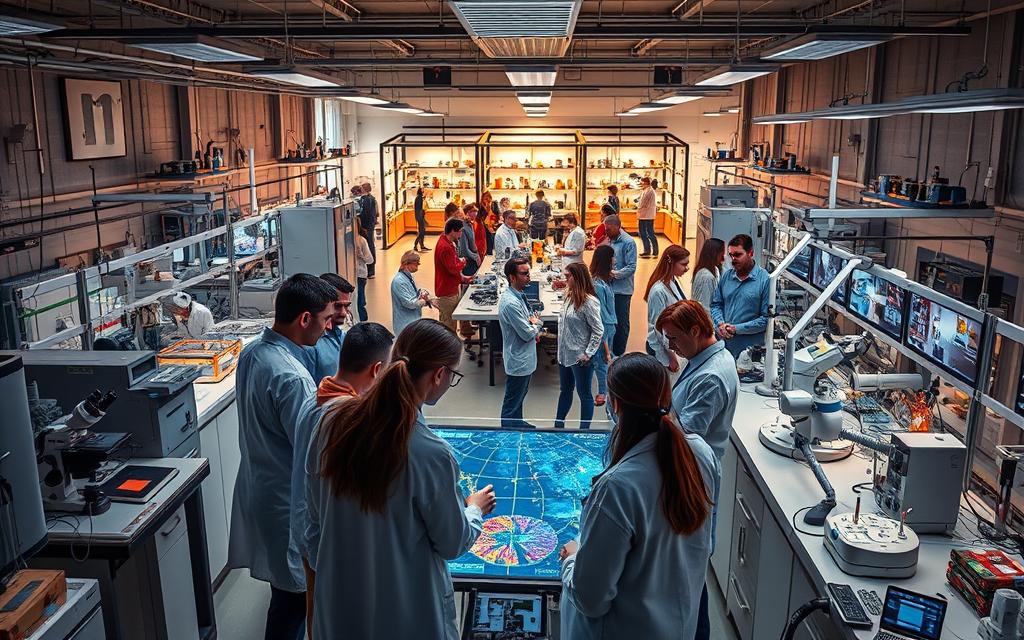
Today, science is breaking down barriers between different fields, thanks to technology. This change is moving research from old ways to new, more complete methods. It’s a big shift in how we do science.
Breaking Down Traditional Discipline Barriers
New tech has opened doors for combining different sciences. Tools like advanced computers help mix methods from one field with another. This creates new areas of study we never thought of before.
Bioinformatics merging biological and computational sciences
Bioinformatics is a great example of science coming together. It mixes biology, computer science, and info tech. This field uses computers to understand life, making discoveries in genetics and drug making that were once impossible.
Computational social science methodologies
Now, social sciences use computers too. They use big data and models to study society. This helps us understand things like the economy and culture in new ways.
Carnegie Mellon University shows how different fields can work together. They use AI to mix chemistry, computer science, and engineering. This way, they make discoveries that no one field could do alone.
Collaborative Tools for Cross-Disciplinary Innovation
Technology has made it easier for scientists to work together. It gives them tools to share data and collaborate. This helps teams from different places and fields work well together.
Shared digital research environments
Cloud platforms and virtual labs let scientists team up in real-time. These spaces offer shared tools and data. This makes working together across fields easy and smooth.
Standardised data exchange protocols enabling collaboration
Having common data formats is key for working together. It lets scientists from different areas understand and use each other’s data. This avoids problems and makes research better.
| Technology Type | Interdisciplinary Application | Impact Level |
|---|---|---|
| Cloud Computing Platforms | Multi-institution research projects | High impact |
| Data Standardisation Protocols | Cross-disciplinary data sharing | Essential |
| Collaborative Software Tools | Real-time research coordination | Moderate to high |
| API Integration Systems | Tool interoperability across fields | Growing importance |
Technology brings together different views in science. This way, teams can solve big problems from many sides. It leads to deeper understanding and new ideas that go beyond old ways of thinking.
Challenges in Technological Adoption and Implementation
Technological advancements bring great benefits for science, but they also face big challenges. These challenges are barriers that need to be overcome. They ensure everyone has fair access and uses technology wisely.
Data Management and Security Considerations
The move to digital research brings new data management needs. Researchers must find a balance between making data easy to access and keeping it safe, mainly with sensitive information.
Protecting sensitive research data in cloud environments
Cloud storage helps with research teamwork but raises security worries. To keep data safe, institutions need strong encryption and access controls. Regular checks and audits are key to keeping research secure.
Ethical frameworks for data sharing and utilisation
Creating rules for data use is a big challenge. Research groups need clear policies on consent, data privacy, and sharing. These rules must grow with technology to keep trust and ethics high.
Addressing the Digital Research Divide
Access to technology varies a lot between places, leading to big gaps in research. This divide makes it harder for some research groups to keep up.
Resource disparities between well-funded and developing institutions
MIT FutureTech found that companies often lead in AI use, leaving schools behind. This imbalance affects research quality and speed. Here’s a look at the differences:
| Resource Category | Well-Funded Institutions | Developing Institutions |
|---|---|---|
| Computing Infrastructure | High-performance clusters | Basic computing facilities |
| AI Development Tools | Comprehensive AI suites | Limited open-source options |
| Cloud Storage Capacity | Unlimited enterprise plans | Restricted free tiers |
| Security Systems | Advanced threat protection | Basic security measures |
Training programmes for digital research skills development
To close the technology gap, we need to invest in education. Training should cover both skills and ethics. It should include:
- Hands-on workshops for new research tech
- Learning with industry partners
- Mentorship for new and experienced researchers
- Continuous learning courses
Overcoming these challenges needs teamwork from funders, schools, and policy makers. With the right plans, science can use technology fairly and safely.
Future Frontiers: Emerging Technologies in Research
The world of science is changing fast with new technologies. These innovations are set to change how we do research in the future. They will help us overcome current challenges and open up new ways to discover and verify things.
Quantum Computing’s Research Promise
Quantum computing is a big deal for science. It uses special computers called quantum systems. These systems have qubits that can be in many states at once.
This means they can solve problems much faster than old computers. Problems that would take years to solve can now be done in seconds.
Quantum simulations advancing materials science
Quantum systems can simulate how molecules and atoms interact. This is a huge help for finding new materials for things like green energy and medicines.
It lets scientists study complex chemical reactions. These reactions were too hard to study before.
Quantum encryption for secure research data transmission
Quantum encryption makes sharing research data safe. It uses quantum mechanics to spot any attempts to spy on the data.
This means researchers can share their findings safely. They don’t have to worry about their work being stolen or tampered with.
Blockchain for Research Integrity and Transparency
Blockchain is changing how we keep research honest. It uses a system that can’t be changed. This makes sure all records are safe and true.
Immutable research data recording systems
Blockchain can record every step of research. From the start to the end, it keeps a permanent record. This stops anyone from changing the data later.
Places all over the world are trying out blockchain for their research. It’s a new way to keep records safe.
Smart contracts for automated research verification
Smart contracts can check research on their own. They make sure everything follows the rules without needing a person to check.
This makes checking research faster and fairer. It stops any unfairness in the checking process.
As MIT FutureTech says, these new technologies are a big step forward. They will make research better by improving how we do calculations, keeping data safe, and making everything more open.
Conclusion
Technology has changed science a lot. The digital world has made it easier to gather, study, and share information. Tools like artificial intelligence and cloud computing speed up research.
These technologies help scientists work together better and analyse data faster. They can solve big problems with the help of computers and global teams. Services like Google Cloud and Amazon Web Services make powerful tools available to everyone.
But, there are also big challenges. Keeping data safe, thinking about ethics, and making sure everyone has access are important. Scientists must use technology wisely to keep research honest and reliable.
Future technologies like quantum computing and blockchain will change science even more. They will help us solve big problems faster and bring together different fields of study.
FAQ
How has technology accelerated scientific discoveries?
Technology has sped up science by making data processing quicker and automating tasks. It also helps scientists work together worldwide. Tools like AI and big data analytics let researchers handle huge amounts of data fast. Questions about affects scientific research also connect with nanometer scale semiconductor design when readers compare closely related topics. This leads to big leaps in fields like genomics and climate science.
What role does artificial intelligence play in modern scientific research?
AI changes research by making it easier to come up with ideas, do experiments, and analyse data. For example, AI can predict protein structures and find patterns in data. This makes research more efficient and helps solve long-standing problems.
How does cloud computing democratise access to research tools?
Cloud computing makes top-notch tools available to everyone. Platforms like Microsoft Azure and Google Cloud offer access to powerful resources for a fee. This helps smaller places and encourages global teamwork by sharing digital spaces.
What are the key challenges in adopting new technologies in research?
Big challenges include keeping data safe and making sure everyone has access. There’s also the need for training. Solving these problems needs work in policy, funding, and education to make tech fair and useful.
How is big data analytics used in scientific research?
Big data analytics looks through huge amounts of data to find patterns. It’s used in places like the Large Hadron Collider and in healthcare. This helps scientists find new things by spotting connections that were hard to see before.
In what ways does technology enhance interdisciplinary research?
Technology helps different fields work together by providing common platforms and tools. It lets scientists from biology and computer science team up. This leads to new ideas and ways of solving problems.
What emerging technologies are shaping the future of scientific research?
Quantum computing and blockchain are changing science. Quantum computers can do complex simulations and keep data safe. Blockchain ensures research is honest and open, opening up new ways to do science.
How do advanced imaging technologies contribute to scientific observation?
Tools like cryo-electron microscopy and the James Webb Space Telescope let us see things never seen before. They give us detailed data that, with AI, leads to major discoveries. This is true in fields like biology, astronomy, and medicine.