


Artificial intelligence is a branch of computer science that creates intelligent machines. These machines can do tasks that humans usually do.
This technology includes learning, reasoning, and solving complex problems. It’s not just in science fiction anymore. AI technology is part of our everyday lives.
For example, navigation systems learn your usual routes. Recommendation engines suggest things you might like. Virtual assistants like Siri and Alexa show how natural language processing is now common.
This field is changing many areas, like healthcare, finance, and education. As we learn more, you’ll see how artificial intelligence is changing our world in amazing ways.
Defining AL Technology: What Does AL Technology Mean?
Artificial intelligence is a big change in technology, but it’s often not clear what it means. At its heart, AL technology is about making computers do things that humans used to do.
“AL” stands for Artificial Intelligence, covering simple tasks like recognizing patterns to complex problem-solving. These systems can learn, reason, see, and make decisions using special algorithms.
The Origins and Evolution of Artificial Intelligence
Thinking about machines that think goes back to ancient Greece. But the real start of AI as we know it was in the 1950s.
Alan Turing wrote a key paper in 1950 called “Computing Machinery and Intelligence”. He suggested a test to see if machines could think like humans. This idea was a big step forward for AI.
Related Posts:






The Dartmouth Conference in 1956 marked the start of AI as a science. After that, there were ups and downs in AI’s progress, known as “AI summers” and “AI winters”.
Now, thanks to better computers and more data, AI is making huge strides. New methods like machine learning and neural networks are helping AI do amazing things.
Common Misconceptions About AL Technology
There are many myths about AI, thanks to movies and books. It’s just as important to know what AI can’t do as what it can.
AI doesn’t have feelings or consciousness like humans do. It can pretend to have emotions, but it doesn’t really feel them.
Another myth is that AI is always fair and unbiased. But AI can pick up and even make biases worse if the data it’s trained on is biased. This means we need to watch how AI is used carefully.
Many people worry that AI will take all our jobs. But most of the time, AI helps people do their jobs better, not replace them.
| Common Misconception | Reality | Impact |
|---|---|---|
| AI possesses consciousness | Simulates but doesn’t experience | Ethical development focus |
| AI is completely objective | Can reflect human biases | Requires oversight |
| AI will replace all jobs | Mostly augments human work | Workforce transformation |
| AI understands like humans | Pattern recognition without comprehension | Limited application scope |
Knowing the truth about AI helps us understand what it can do today and what it might do tomorrow. AI is a tool made by humans to help us do more.
Core Concepts and Fundamentals of Artificial Intelligence
To understand artificial intelligence, we must know its basic technologies. These allow machines to learn, reason, and see like us. These ideas are the foundation of today’s AI systems.
Machine Learning: The Engine Behind Modern AI
Machine learning is a big change in AI. Unlike old methods, ML systems learn from data to predict things on their own.
There are three main ways machine learning works:
- Supervised learning: Systems learn from labelled data
- Unsupervised learning: Algorithms find patterns in unlabelled data
- Reinforcement learning: Systems learn by trying and getting rewards
Neural Networks and Deep Learning Architectures
Neural networks are like the human brain. They have nodes that connect and process information. This happens in layers that get better at finding important details.
Deep learning goes further with more layers. It can handle complex data that old methods can’t.

Convolutional Neural Networks are great for images. They use filters to spot things like edges and textures.
CNNs changed computer vision. They learn important features automatically. This is why they’re good for facial recognition and medical images.
Recurrent Neural Networks for Sequential Data
Recurrent Neural Networks deal with data that comes in a sequence. They remember what they’ve seen before.
RNNs are top for analysing time series and natural language processing. They understand the order of things, which is key for translation and speech recognition.
Key Technologies Powering Modern AI Systems
Modern AI systems use advanced technologies to process information and make decisions. These technologies are key for many AI applications today, from voice assistants to self-driving cars.
Natural language processing and computer vision are two major technologies. They help machines understand human language and visual information.
Natural Language Processing Capabilities
NLP lets computers understand, interpret, and create human language. It’s behind many daily apps we use.
Early NLP faced challenges like figuring out word meanings. But now, thanks to word embedding and transformer models, it’s much better.
Today, NLP is used in:
- Voice assistants like Siri and Alexa
- Real-time translation services
- Intelligent chatbots for customer service
- Sentiment analysis tools
These systems go through stages to understand language. They look at syntax, semantics, and context to get the meaning.
Computer Vision and Image Recognition Technologies
Computer vision lets machines ‘see’ and understand visual information. It’s essential for many narrow AI applications.
The field has grown from simple image classification to complex object recognition. Now, systems can track objects and analyse scenes.
Key uses of computer vision include:
- Facial recognition systems
- Autonomous vehicle navigation
- Medical image analysis
- Quality control in manufacturing
These systems use convolutional neural networks to process images. They break down images into features and patterns for analysis.
| Computer Vision Technique | Primary Function | Common Applications |
|---|---|---|
| Image Classification | Categorises entire images | Content filtering, medical diagnostics |
| Object Detection | Identifies and locates objects | Autonomous vehicles, surveillance |
| Semantic Segmentation | Labels each pixel in an image | Medical imaging, autonomous navigation |
| Instance Segmentation | Differentiates between object instances | Robotics, augmented reality |
Natural language processing and computer vision are advancing fast. They are key for modern AI systems to interact with and understand our world.
Major Types of Artificial Intelligence Systems
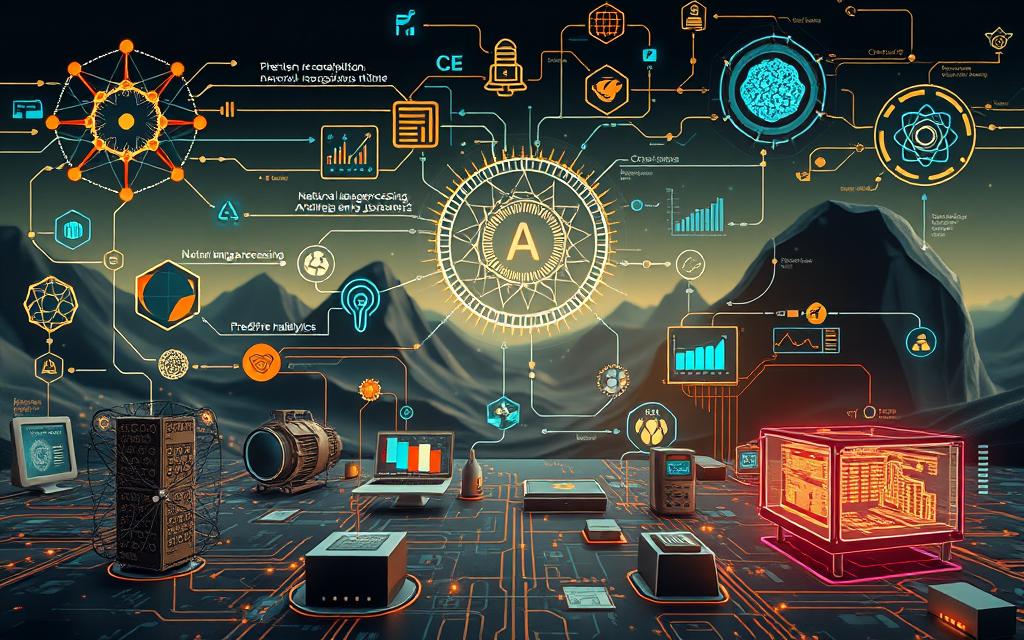
Artificial intelligence systems can be grouped by their abilities and uses. This grouping helps us see where we are now and what’s coming next. It ranges from specific systems to ideas that challenge what machines can do.
Narrow AI vs General AI: Understanding the Spectrum
Most AI today is Narrow AI (ANI). These systems do one thing well but don’t understand more. Examples include chess programs, spam filters, and voice assistants.
Artificial General Intelligence (AGI) is about machines that think like humans. They could learn and apply knowledge in many areas. But, true general AI is something we’re working towards, not yet here.
Then there’s Artificial Superintelligence (ASI). This is a system smarter than humans in almost everything. The idea of creating such a system is debated, and what it could mean for us is a big question.
| AI Type | Capabilities | Current Status | Examples |
|---|---|---|---|
| Narrow AI (ANI) | Specialised task performance | Widely deployed | Chatbots, recommendation engines |
| General AI (AGI) | Human-like understanding | Theoretical research | None currently existing |
| Superintelligence (ASI) | Superhuman capabilities | Hypothetical concept | Pure speculation |
Reactive Machines and Limited Memory Systems
Reactive AI systems don’t remember the past. They just react to what’s happening now, using set rules. IBM’s Deep Blue chess computer is an example, as it doesn’t recall past games.
Limited memory systems are a big step up. They can learn from recent data and experiences. Modern self-driving cars are an example, constantly processing new information to make decisions.
Going from reactive to limited memory systems is a big leap in AI. It makes AI more adaptable and responsive in complex situations.
Theoretical Concepts: Theory of Mind and Self-Aware AI
Theory of mind AI is about machines understanding human feelings and thoughts. They would know what others believe, want, and intend. This would change how humans and machines work together.
Self-aware AI is the most dreamy idea in AI. These systems would be conscious and understand themselves like humans. But, we’re far from making this a reality.
Both ideas make us think deeply about what AI could be. Researchers are exploring these ideas, facing big technical challenges along the way.
Real-World Applications of AL Technology
Artificial intelligence has moved beyond theoretical concepts to deliver tangible benefits across numerous industries. These practical implementations demonstrate AI’s transformative power in solving complex problems and improving efficiency.
Healthcare Innovations Powered by Artificial Intelligence
The healthcare sector has embraced artificial intelligence to enhance patient care and medical research. AI systems analyse vast amounts of medical data to support clinical decisions and accelerate discoveries.
Medical Imaging and Diagnostic Assistance
AI algorithms excel at interpreting medical scans with remarkable precision. These systems detect subtle patterns in X-rays, MRIs, and CT scans that human eyes might miss.
Radiologists now use AI-powered tools to identify tumours, fractures, and other abnormalities more accurately. The technology reduces diagnostic errors and speeds up treatment planning.
Drug Discovery and Development Acceleration
Pharmaceutical companies leverage AI to revolutionise medication development. Machine learning models predict how molecules will interact, saving years of laboratory testing.
These systems analyse existing research data to identify promising compound candidates. AI accelerates the entire drug development pipeline from initial discovery to clinical trials.
Financial Services and Fraud Detection Systems
Banks and financial institutions employ artificial intelligence to protect customers and optimise operations. AI systems monitor transactions in real-time to identify suspicious patterns.
Modern fraud detection uses machine learning to analyse spending behaviours and flag anomalies. These systems learn from each transaction, constantly improving their accuracy.
Financial organisations also use AI for:
- Algorithmic trading strategies
- Credit risk assessment models
- Personalised financial advice
- Customer service automation
| Application Area | AI Technology Used | Key Benefits | Implementation Examples |
|---|---|---|---|
| Medical Diagnostics | Deep Learning Networks | Improved accuracy, faster results | Cancer detection in mammograms |
| Pharmaceutical Research | Predictive Analytics | Reduced development time | COVID-19 treatment identification |
| Financial Security | Pattern Recognition | Real-time fraud prevention | Credit card transaction monitoring |
| Investment Management | Algorithmic Systems | Optimised portfolio performance | Automated trading platforms |
The integration of artificial intelligence across these critical sectors demonstrates its practical value. These applications address real-world challenges while raising important questions about AI ethics and the future of AI development.
AI in Everyday Life: Consumer Applications
Artificial intelligence has changed how we use technology at home and for fun. It makes our experiences feel personal and magical. These AI uses are all around us, making our daily lives easier and more advanced.
Virtual Assistants and Smart Home Integration
Voice-activated helpers like Amazon’s Alexa, Google Assistant, and Apple’s Siri have grown a lot. They now manage our homes, understanding us better with each command. They can control lights, temperature, and even entertainment with just our voice.
These smart homes are getting smarter. They can predict what we need before we ask. This is thanks to AI that learns our habits and likes.
Google’s Gemini Live is the latest step in this tech. It talks to us more naturally and helps us out more. It uses machine learning to get better at understanding us and our homes.

Recommendation Systems in Entertainment Platforms
Services like Netflix, YouTube, Amazon Prime, and Spotify use AI to find the right shows and music for us. They look at what we watch and listen to, and even when we watch or listen. This helps them guess what we’ll like next.
These systems use neural networks to understand what we like. They look at what others like too. This way, they find shows and music that are just right for us.
YouTube’s system is very good at keeping us watching. Netflix’s is great at finding shows we might not find on our own. They both make us feel like they really get us.
The Business Impact of Artificial Intelligence
Artificial intelligence is changing how companies work and compete today. It brings real benefits like better efficiency, smarter choices, and new ways to stay ahead. These changes were once hard to imagine.
Companies that think ahead are using AI to change how they work. They use intelligent systems to improve how they use resources and find new ways to grow. This is a big change in how they plan their business, not just a new tech tool.
Automation and Process Optimisation in Enterprises
Today, companies are using AI to make their work smoother and cut down on manual tasks. These systems do tasks over and over again with great accuracy. This lets people focus on more important tasks.
AI is used in many areas, like making robots for assembly lines and chatbots for customer service. It also helps with data entry, invoices, and keeping track of stock. This makes work flow better across different parts of the company.
AI does more than just replace tasks. It can also make processes better by finding and fixing problems. It can change how things work in real-time, something old systems can’t do.
For example, banks use AI to spot fraud quickly, looking at thousands of transactions every second. Shops use it to plan their stock better. These examples show how deep learning can change key parts of a business.
Data Analytics and Business Intelligence Enhancement
AI has changed how companies deal with data. Old ways couldn’t handle the amount, type, and speed of data today. AI systems are great at finding important information in big datasets.
AI tools can look at all kinds of data at once. They find things that people might miss. This turns raw data into useful information for making big decisions.
Thanks to natural language processing, AI can understand what people are saying online and in feedback. This helps companies know what their customers think and how they stand in the market.
AI also helps predict what will happen next in the market and what customers will want. This lets companies plan better, using data to guide them. This way of thinking ahead gives them an edge over others.
The effect of AI on business is growing as technology gets better. Companies that use these tools are well-positioned for success in a world that values data. The changes go beyond just making things more efficient. They change how companies make and deliver value.
Ethical Considerations in AI Development
Artificial intelligence is now a big part of our lives. We must think about fairness, privacy, and who’s responsible. These are big questions that need careful thought.

Bias and Fairness in Algorithmic Decision-Making
AI can sometimes show biases from the data it’s trained on. This happens because it learns from data that might be unfair.
In jobs, loans, and law, biased AI can be unfair. For example, facial recognition can make mistakes with some groups.
To fix this, companies are working hard. They’re checking their AI, using diverse data, and making algorithms fairer. This makes AI more just for everyone.
Privacy Concerns and Data Protection Challenges
AI needs lots of data, which raises privacy worries. Many AI tools, like narrow AI, handle a lot of personal info.
Following rules like GDPR is tough for AI makers. These rules want data use to be clear and let people control their info.
AI surveillance raises big questions too. We need to find a balance between keeping us safe and respecting our privacy.
Accountability and Transparency in AI Systems
It’s hard to say who’s to blame when AI goes wrong. Unlike people, AI can’t be held accountable.
Explainable AI helps make things clearer. It shows how AI makes decisions, which builds trust.
Companies need to set clear rules for AI. This includes keeping records, testing, and having humans check things. For more on this, check out our guide on ethical considerations of artificial intelligence.
Good rules and checks keep AI in line with what’s right. Regular checks help AI stay true to our values.
The Future Landscape of Artificial Intelligence
Artificial intelligence is changing fast, bringing big changes to our world. The current AI boom, with new technologies like generative AI, is just the start. It shows us what intelligent systems can do.

Emerging Trends and Technological Advancements
Innovation in AI is speeding up. Generative AI can create all sorts of content, from text to images. It’s getting better and better, making more complex things.
AI agents and agentic systems are also exciting. They can do complex tasks on their own, without needing us all the time. This is a big step towards more independent AI.
Multimodal AI is another area to watch. These systems can handle different types of data at once. This makes them more like us, as we see and hear the world in many ways.
AI is also getting better at using less energy. New chips and algorithms are making AI faster and more efficient. This means AI can be used in more places, in a more sustainable way.
The goal of general AI is to make systems that can do anything. But we’re not there yet. Current AI is great at specific tasks, but we’re working on making it more flexible and adaptable.
Potential Societal Impacts and Transformations
AI will change how we work in many industries. Some jobs will change, while others might disappear. We need to think about how to prepare for this.
Education will play a big role in adapting to an AI world. Schools will focus on skills that work well with AI. Things like thinking critically, being creative, and understanding emotions will be more important.
AI can also make healthcare better. It can help doctors make more accurate diagnoses and create treatment plans that are just right for each person. AI can even help us monitor health from a distance, changing how we care for each other.
AI will also change how we plan cities and build infrastructure. Smart cities use AI to make traffic flow better, use energy more efficiently, and improve public services. This makes life better and helps the environment.
AI will also change how we create and interact with each other. It can help us make art, music, and communicate in new ways. This can lead to new forms of expression and connection.
But there are challenges too. AI could replace some jobs, which means we need to think about how to support people. We need to create new safety nets and help people learn new skills.
There are also security concerns with AI. As AI gets stronger, we need to make sure it’s safe. This includes protecting against cyber threats and making sure AI is used responsibly. Working together globally will be key to solving these problems.
We need to create rules for AI that encourage innovation but also protect us. These rules should help us use AI’s benefits while avoiding its risks. This is a big challenge, but it’s essential for the future.
The future of AI is full of possibilities and challenges. How we handle these will shape our world for years to come.
Conclusion
Artificial intelligence is a major breakthrough in technology. It involves systems that can do things that humans usually do. Today’s AI uses machine learning and neural networks to do amazing things.
AI is used in many areas, like healthcare and finance. It helps find diseases and spot fraud. It also suggests products to customers. These examples show how AI solves big problems and helps us make better choices.
But, there are ethical concerns with AI. We need to deal with bias, privacy, and how clear AI systems are. Making sure AI is developed responsibly is key. This way, AI can help us, not harm us.
The future of AI looks bright. It will change many areas, from business to science. The key is to use AI in ways that benefit everyone. We must make sure AI works for the good of all.
FAQ
What is artificial intelligence?
Artificial intelligence means computers that can do things humans do, like learn and solve problems. It’s not just in movies but is part of our daily lives. Think of apps that help you navigate or recommend things.
How did artificial intelligence develop?
The idea of AI started with ancient Greeks. But it really took off in the 1950s with Alan Turing’s work. Today, AI is getting better fast thanks to more computing power and data.
Does artificial intelligence possess consciousness or emotions?
No, AI systems don’t have feelings or self-awareness. They act smart by following rules in their programming. But they don’t truly understand or feel things like we do.
What is the difference between machine learning and artificial intelligence?
AI is about machines acting smart. Machine learning is a way AI learns from data. It uses different methods to get better over time.
How do neural networks work in artificial intelligence?
Neural networks are like the brain but for computers. They learn by changing how they connect information. This lets them solve complex problems.
What is natural language processing?
Natural language processing lets machines understand and talk like humans. It’s used in voice assistants and translation. New methods help machines understand words better.
How is artificial intelligence used in healthcare?
AI helps in healthcare by looking at medical images and finding problems. It also helps find new medicines faster. This makes doctors’ jobs easier.
Can artificial intelligence be biased?
Yes, AI can be biased if it learns from unfair data. This can lead to unfair decisions. Fixing this means using fair data and checking AI often.
Will artificial intelligence replace human jobs?
AI will change jobs, but it won’t replace all of them. It’s good at repetitive tasks, freeing humans for creative work. We’ll need to learn new skills.
What are the privacy concerns with artificial intelligence?
AI needs lots of data, which raises privacy worries. It’s important to follow rules like GDPR and handle data carefully. Companies must protect personal info.
What is the difference between narrow AI and general AI?
Narrow AI does specific tasks, like recognizing images. General AI would be as smart as humans. But we’re not there yet.
How do recommendation systems like those on Netflix work?
Netflix uses AI to suggest shows based on what you watch. It looks at your preferences to find new things you might like. This makes watching more fun.
What ethical considerations are important in AI development?
Ethics in AI include fairness, privacy, and clear answers for mistakes. Making AI decisions clear helps solve these issues. This makes AI more trustworthy.
What emerging trends are shaping the future of artificial intelligence?
New AI trends include creating original content and doing tasks on their own. They also handle different types of data and use less energy. These changes make AI more useful and efficient.
